
For years, cycle tourism has been described with one very convenient word: potential.
The potential of inland areas. The potential of secondary roads. The potential of cycle routes. The potential of accommodation able to welcome people travelling by bike.
All true. But at some point, potential stops being enough.
To grow, a sector needs to start measuring itself. It needs to understand where it's working, where it can improve, which territories are attracting cyclists from abroad, and in which months they do it best.
That need is what produced the Cycle Tourism Index 2026, the new study by Bikenomist and komoot, presented at the Cycle Tourism Show in Padua. The report offers a data-driven, comparative reading of how attractive European regions are to international cyclists. It's built on aggregated cycling activity data recorded in 2025 across 14 European countries, and introduces both an annual index and four seasonal indices.
You can read the full Cycle Tourism Index 2026 report here.
What the Cycle Tourism Index measures
The Cycle Tourism Index aims to estimate, in a comparable way, the relative attractiveness of European regions to cyclists arriving from abroad, based on observed digital cycling activity.
The index shifts the conversation from storytelling to strategy. It's no longer enough to say a place "is nice to ride in." You need to know whether that place is actually chosen, when in the year, and how strongly compared with similar destinations.
The new geography of European cycle tourism
The first thing that emerges from the report is clear: European cycle tourism has a very readable geography.
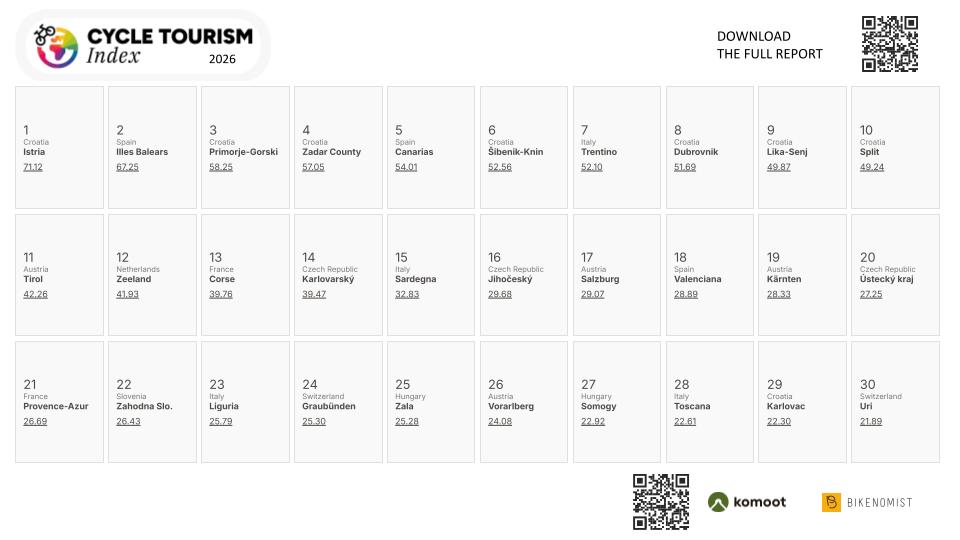
The strongest regions cluster around Mediterranean and Alpine areas, where landscape, climate, quality of the tourism experience and cycling appeal add up to a recognisable offer. The annual ranking is led by Istria in Croatia with 71.12 points, the Balearic Islands in Spain with 67.35, and Primorje-Gorski Kotar in Croatia with 58.25. They're followed by Zadar County, the Canary Islands, Šibenik-Knin, Trentino-Alto Adige, Dubrovnik-Neretva, Lika-Senj and Split-Dalmatia.
But the most interesting finding isn't just who wins.
It's how some territories win.
Croatia, for instance, doesn't appear in the ranking as a single isolated destination. It enters as a genuine Adriatic system: Istria, Primorje-Gorski Kotar, Zadar County, Šibenik-Knin, Dubrovnik-Neretva, Lika-Senj and Split-Dalmatia form a continuous, recognisable stretch. The message is strong: in cycle tourism, having one excellent spot isn't enough — you need a legible chain of territory that foreign visitors can understand and choose.
Italy is there, but needs to become a system
For Italy, the picture is positive, but not yet compact.
Trentino-Alto Adige is the best-placed Italian region in the overall ranking, at seventh place, and shows up consistently in the seasonal rankings too. Sardinia, Liguria and Tuscany also make the annual top 30.
So the point isn't that Italy lacks strong territories. It has them.
The point is that, according to the report, the country still looks like a collection of very good areas rather than a fully compact, coherent national system on the international cycle tourism market.
And that's exactly where the Cycle Tourism Index becomes useful: it's not just there to celebrate the leaders, but to show where the room for improvement is. A cycle tourism destination isn't built from a bike path, a nice route or a promotional campaign alone. It's built when infrastructure, services, hospitality, storytelling and territorial continuity start speaking the same language.
Cycle tourism changes shape with the seasons
One of the study's most important findings concerns seasonality.
Cycle tourism doesn't have a single map. It has at least four.
In winter, mild-climate destinations dominate: the Canary Islands, the Balearic Islands and Istria. In spring, the Balearic Islands, Istria and Primorje-Gorski Kotar move to the top. In summer the ranking is led by Istria, Primorje-Gorski Kotar and Zadar County, confirming the strength of the Croatian Adriatic corridor. In autumn, the Balearic Islands, Istria and the Canary Islands return to the top spots.
This changes how you plan.
It's no longer enough to ask whether a destination is attractive. You need to ask when it is. And why.
One region can be very strong in summer but weak the rest of the year. Another may have fewer peaks but spread demand more evenly. A third might discover its real competitive edge isn't August, but October.
For public administrations, tour operators and local businesses, this reading is decisive: it makes it possible to extend the season, spread flows more evenly, use infrastructure better, and make a more stable living for the people who work in bike tourism.
Why this index matters
Cycle tourism is often hard to see.
People travelling by bike don't always arrive in large groups. They don't always pass through a checkpoint. They don't always sleep in the same type of accommodation. Sometimes they move through inland areas, small towns, secondary roads, places traditional tourism statistics struggle to capture.
The risk, then, is twofold: underestimating the phenomenon, or only describing it through impressions.
The Cycle Tourism Index exists to avoid both. It doesn't claim to be a definitive answer, but it offers a first tool for comparison, helping territories move from intuition to evidence, from generic rankings to strategy, from occasional promotion to building a more solid position.