
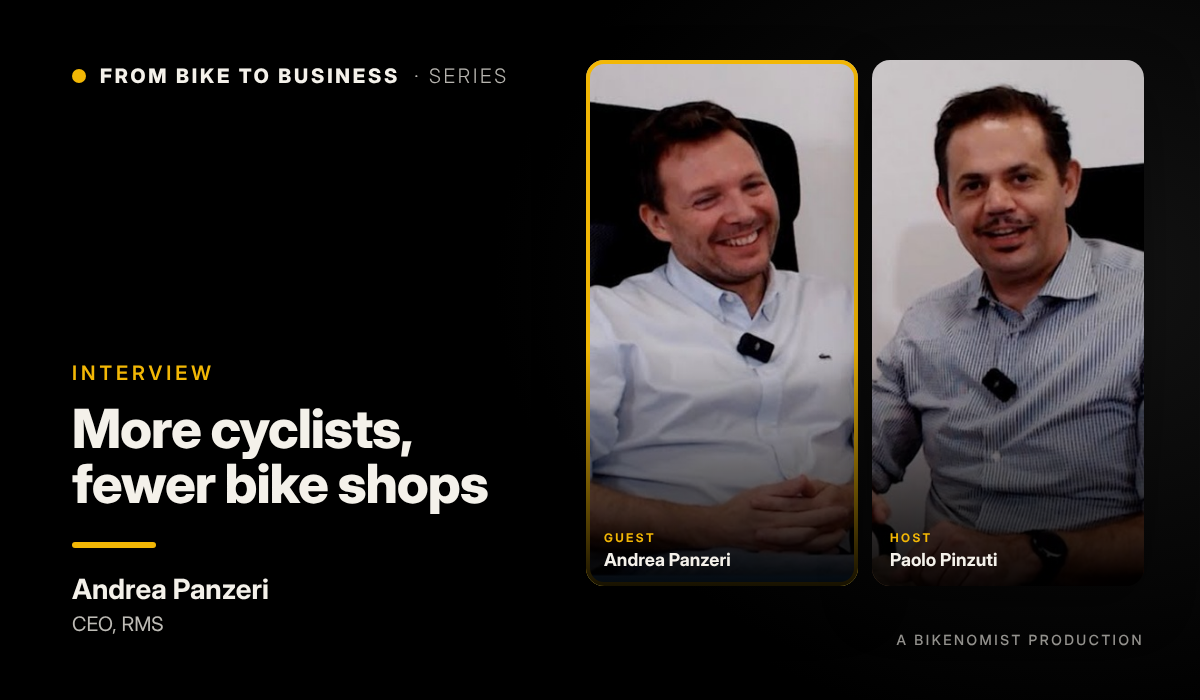
There are more cyclists on the road than ever, yet bike shops keep closing. Bike sales have stalled while cycle tourism grows by double digits every year. It is a paradox that puzzles anyone who walks past a neighbourhood bike shop that no longer sells bikes, only repairs and city rentals for tourists.
Andrea Panzeri, CEO of RMS, knows this world from the inside. RMS supplies spare parts exclusively to bike shops, so it sees their numbers and their problems up close. In this episode of From Bike to Business, Bikenomist's series on the economies of the bicycle hosted by CEO Paolo Pinzuti, Panzeri explains why retailers are struggling and what they can do about it.
Why bike shops struggle
According to Panzeri, the sector is alive but slowing down. The enthusiasm of cyclists and the growth of cycle tourism are not enough to offset an uneven market, where bikes keep getting more expensive and are still seen mainly as sports equipment rather than a means of transport.
The weak link is the shop itself. In Italy most bike shops are small family businesses, kept going more by passion than by a business structure. Panzeri is clear: "passion alone is no longer enough". Shops need financial skills, a strategy and a long-term vision.
Three levers to turn it around
Panzeri points to three priorities for retailers who want to stay in business:
- Solid financial management. Know your balance sheet and your cash flow, so you never find yourself without margins.
- A clear identity. A shop that does not know what it wants to be ends up looking like every other shop. Choose who you serve and what you stand for.
- A strong workshop. Service and maintenance are the most effective defence against e-commerce, because no website can replace hands-on work on a bike.
The bigger picture
The problem is also cultural and political. Italy lacks stable policies, adequate infrastructure and incentives for people who ride every day, so the bike stays a weekend object rather than an everyday tool.
Cycle tourism can bring fresh oxygen to the whole supply chain. In 2024 it generated an economic impact of almost €10 billion in Italy. But that potential only turns into business for shops if slow tourism is connected to everyday mobility: the visitor who rents a bike on holiday is the same person who could ride to work at home.
Where the supply chain meets
Bike shops, brands, destinations and tour operators meet every year at the Cycle Tourism Show. The next edition takes place on 19–21 March 2027 at Padova Fiere: a chance for retailers to see where demand is going and to build the partnerships that cycle tourism needs.
Watch the full episode of From Bike to Business with Andrea Panzeri on YouTube, and read the Italian recap on Bikeitalia.