
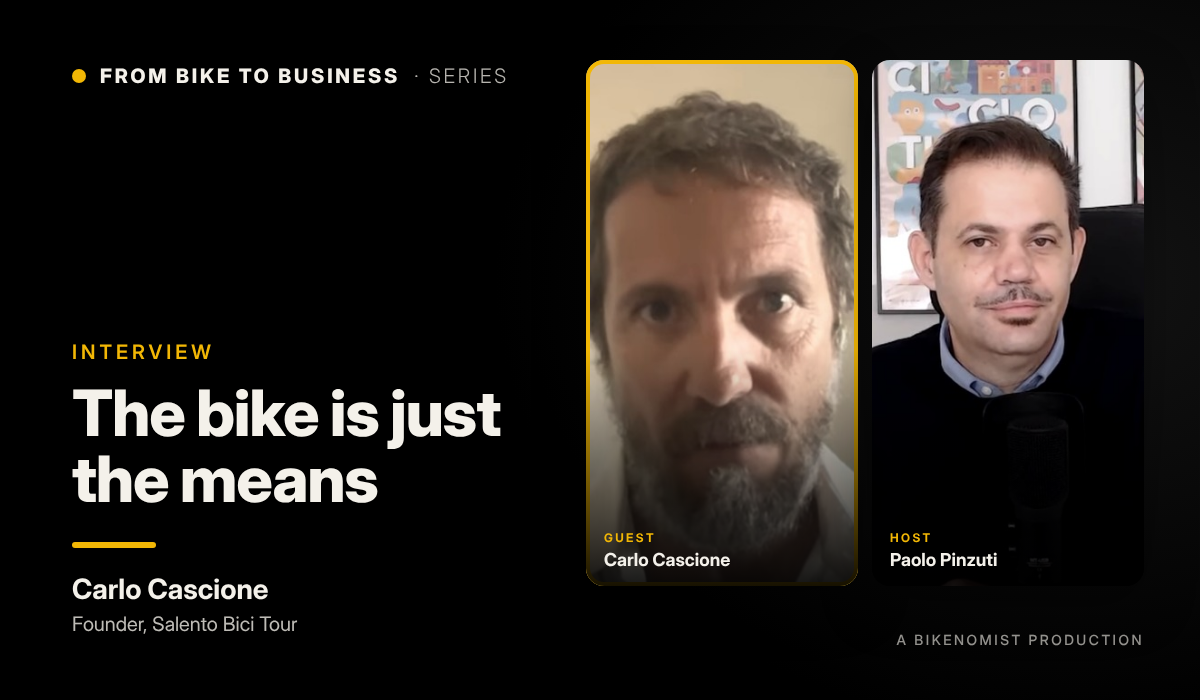
Cycle tourism is seen as a niche today, but it is set to become the standard way we travel. That is the bold forecast of Carlo Cascione, founder of Salento Bici Tour, in this episode of From Bike to Business, Bikenomist’s series on the economies of the bicycle hosted by CEO Paolo Pinzuti.
For fifteen years, Carlo Cascione has been guiding travellers from all over the world to discover the Salento and other regions by bike. His view of where the sector is heading starts from a simple idea: the bicycle is not the point of the journey.
The bike is the means, not the goal
For Cascione, what matters is the journey: the people, the places and the stories met along the way. The bike is simply the vehicle that makes them possible.
That is why he believes the word “cycle tourism” will eventually disappear. Tourism itself will be absorbed by the bicycle, and many trips we now label as cycle tourism will simply be holidays made by bike, in the same way that nobody today calls a road trip “car tourism”.
It is already happening
According to Cascione, this shift is already under way. Food and wine tours, cultural itineraries and language experiences such as “Learning Italian by Bicycle”, which combines rides with Italian lessons, all use the bike as a starting point to build something else.
In this view the bicycle becomes the most logical, enjoyable and sustainable way to move from one experience to the next.
People are the pivot
Cycle tourism only grows if those who work on the ground work together. “People are the pivot,” Cascione says, and he means not only customers but above all operators.
Networking means sharing information and experience, partnering with businesses that offer complementary services and no longer seeing each other as competitors. In Italy this approach is far from a given, and the lack of collaboration remains a cultural barrier that can hold the whole sector back.
The missing piece: institutions
Italian cycle tourism has grown almost without public policy, driven by private companies and associations. Meanwhile Spain, Belgium, Germany and the Netherlands have been working for years on cycle networks, greenways and national active mobility strategies.
Italy does not need grand projects, but it does need decision-makers who actually know the bicycle & cycling: an administrator who rides sees problems and opportunities that otherwise stay invisible. Without a shared vision, Italy risks remaining a highly desired destination that cannot offer a product matching international demand.
The network Cascione calls for meets every year at the Cycle Tourism Show. The next edition takes place on 19–21 March 2027 at Padova Fiere, with a B2B day bringing together destinations, bike brands and operators, followed by two days open to the public.
Watch the episode on youtube, read the original Italian article on Bikeitalia.