
The annual analysis by ADFC (the German Cycling Federation) reveals a significant shift in the European market. While nearly 40 million Germans cycle in their free time, there is a noticeable move away from long-distance touring in favor of day trips and occasional cycling during "stationary" holidays.
This report carries the weight of the ADFC ( ADFC Allgemeiner Deutscher Fahrrad-Club e. V. ), the world’s largest cycling association with over 240,000 members. Beyond data monitoring, ADFC acts as a powerful legal and technical consultancy, politically driving consistent cycling promotion on an international scale.
According to the ADFC Radreiseanalyse 2025—a representative survey involving a record 17,300 participants—approximately half of German adults use a bicycle during their holidays or leisure time. However, despite a pool of 39.3 million active cyclists, the sector faces new challenges: while e-bike usage and average per capita spending are rising, classic multi-day touring and day excursions have seen a decline.
Market Figures: Fewer Tours, More "Cycling during the Vacation"
The analysis breaks the market into four segments, showing contrasting trends compared to 2023:
- Cycle Tours (3+ nights): 3.3 million people undertook a stage-based trip (down from 3.6 million in 2023). On average, these trips last 7.6 days.
- Short Trips (1-2 nights): This segment also fell, from 5 million to 4.2 million. May and June remains the preferred months for long weekends.
- Day Excursions: The most dramatic drop, falling from 455 million excursions in 2023 to 361 million in 2025.
- Cycling during the Holiday: The only growing segment. 12.7 million Germans used a bike during a different type of holiday (relax, family, beach), up from 10.6 million two years ago.
Why the decline? Experts cite unstable weather in July 2025, rising costs, and an increasing desire for holidays focused on total relaxation and family, rather than constant physical exertion.
The E-bike Factor: An Inclusive Revolution
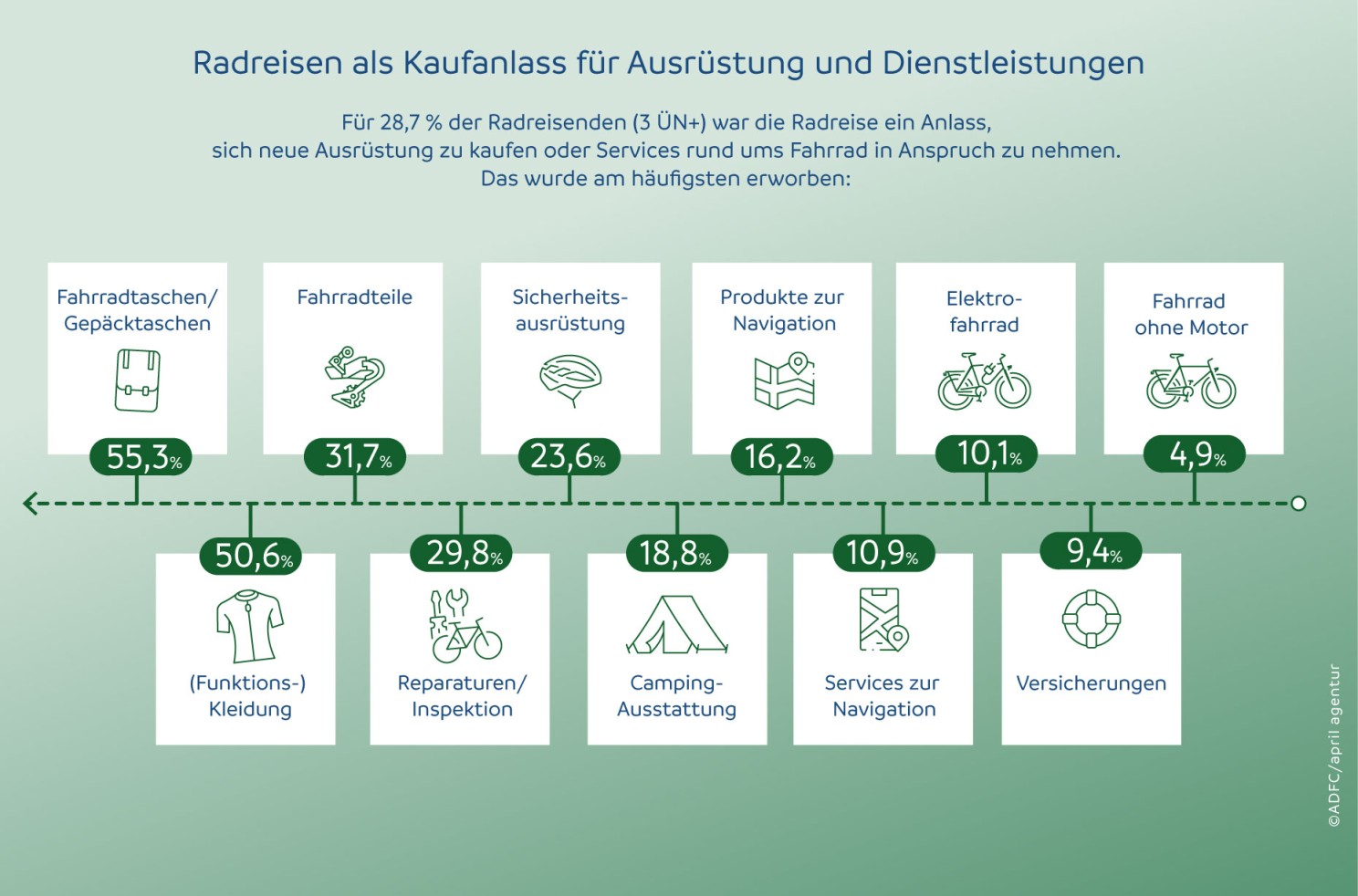
The most significant data concerns propulsion: one in two cycle tourists now travels on an e-bike (pedelec). This technological shift is making cycle tourism accessible to those who previously didn't feel fit enough for hilly terrain or long distances. Equipment remains a priority: 29% of respondents bought new accessories for their trip, led by panniers, technical clothing, and components. Interestingly, among those who invested in a new bike for the occasion, the ratio of electric to muscular was 2 to 1.
The Pedal Economy: What does a cycle tourist spend?
Despite the drop in total travelers, the economic impact remains massive: between €38.7 and €41.8 billion in 2025. Average daily spending has increased—partly due to the shift from campsites to hotels—ranging between €133 and €144 per person, per day.
Infrastructure and Trains are Essential
Christian Tänzler, tourism expert at ADFC, emphasizes the need for continued investment: "The potential is enormous: 50% of those who have never taken a bike trip say they are interested in doing so. To attract them, we need targeted measures: safe and well-maintained cycle paths, simplified bike transport on trains, and specific offers for families and beginners."
What does this mean for Italy and beyond?
The 2025 Radreiseanalyse is a strategic compass for the Italian market. Italy remains a top destination for German cycle tourists, securing its spot on the podium of the most attractive foreign destinations. Our country ranks second overall both for "cycling on holiday" (occasional use) with a 20.0% share, and for structured bike trips (3+ nights) at 25.9%. While in the former case, Italy follows the Netherlands (25.0%), in multi-day trips it is preceded only by Austria (28.3%), outperforming nations with strong cycling traditions like France and Denmark.
As Director of theCycle Tourism Show ( Fiera del Cicloturismo) and board member of EuroVelo/European Cyclists’ Federation, I believe these figures are a vital signal for Italian destinations: The German tourist, among our primary foreign visitors, increasingly seeks nature, relaxation, and safety. The growth of the 'Cycling during the Holidays' segment suggests that major cycle routes alone are no longer enough. We need capillary local networks that allow those staying in hotels or resorts to explore the territory on two wheels, ideally with a rental e-bike.
The shift from 'the great feat' of 500km toward a more experiential and local use of the bicycle indicates that Italy and beyond must accelerate its regional connectivity. If the tourist wants to cycle starting from their holiday base, local services become crucial: quality e-bike rentals, signage for local loops, and truly bike-friendly accommodations.
Cycling Brainwasher @ Bikenomist
Director Cycle Tourism Show | Member of EuroVelo Council | Women in Cycling Ambassador
Photo Credit: ADFC-TMN_DZT__Jens_Wegener_Weser-Radweg